
Worn, torn, reborn: Inside a FACS-led textile recycling program
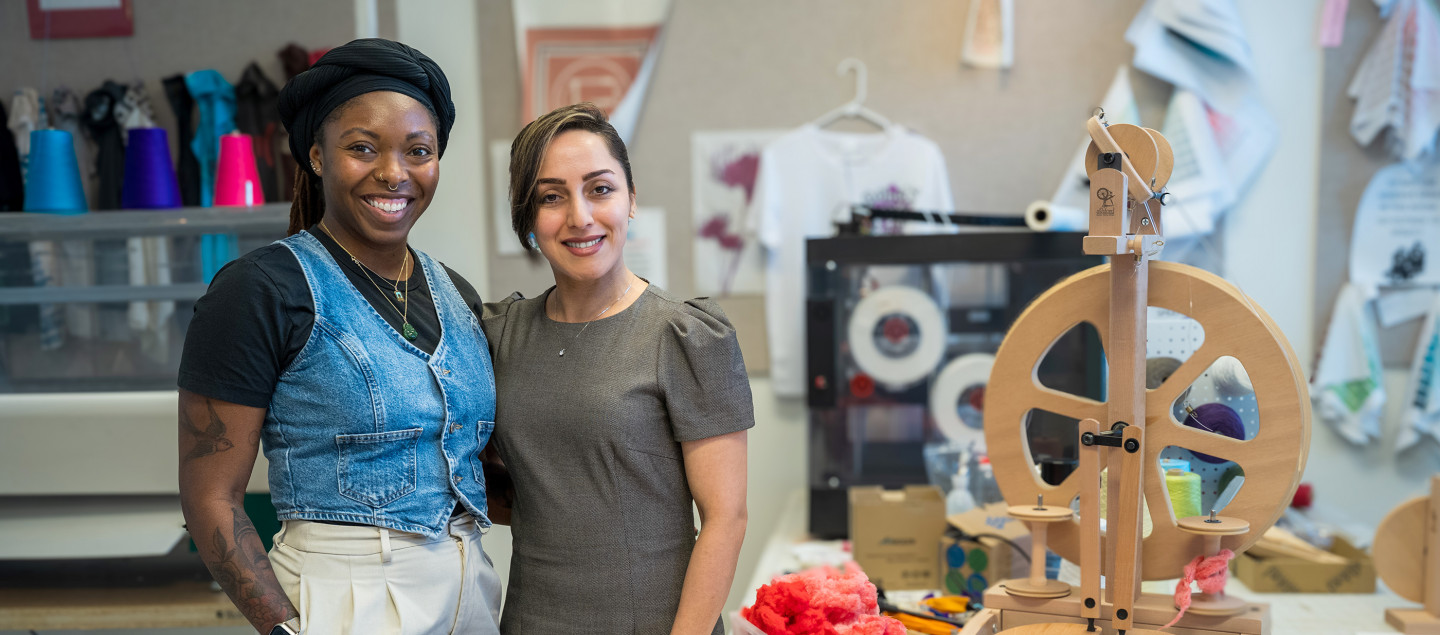
Sha’Mira Covington knows all about circularity. An assistant professor of fashion in the College of Family and Consumer Sciences, Covington studies methods for infusing sustainable consumerism into fashion merchandising. Is it possible, Covington wonders, to implement a circular economy—at least one involving clothing and textiles—in a small community like a university?
As part of her research, three years ago she worked with Ph.D. student Mozhgan Soltanisehat to implement a textile recycling program on campus. The effort now involves 15 FACS students and multiple collection bins placed in buildings around campus. Since 2023, the project has collected about 500 pounds of materials, which they work to upcycle or recycle depending on the item and its components.
Upcycling clothing involves changing a garment into a different type of garment—cutting off the sleeves, adding embellishments, etc. Recycling clothing involves turning the garment into something completely different, and that can be a significant challenge based on the materials used.
“You can’t separate the materials,” Covington said. “If you’ve got a cotton-poly blend, it stays a cotton-poly blend. The cotton and the polyester are woven together. Usually textile recycling on industrial scale produces material for insulation, for carpets. We’re hoping we can turn textiles we collect on campus into an end-use product that can be seen and touched and enjoyed.”
Would Bulldog Nation be in the market for recycled-fiber stadium seat cushions or branded blankets? That’s a question Covington hopes to answer, perhaps using FACS equipment like textile shredders, spinners, and weavers to make the products. Like UGArden, FACS also provides an opportunity for experiential learning in entrepreneurship through Couture A La Cart, a pop-up boutique directed by senior lecturer Claire McClure and run by students and that sells jewelry, clothing, and other accessories.
The Swap Shop, a free exchange store (donations accepted) located in the Miller Learning Center, also contributes to this experiment. Operated by the Office of Sustainability in space donated by University Libraries, the shop accepts donations of clothing and many other items. When it receives donations of clothing it can’t use, it often redirects the materials to Covington.
The Swap Shop itself was launched through an Office of Sustainability Campus Sustainability Grant (as was Gross and Novajosky’s herb separator project). In fact, Kirsche said his office—and specifically its student interns—support each program mentioned in this article and continue to catalyze new sustainability research on campus.
“UGArden and our office grew up together,” Kirsche said. “It’s been a collaborative connection for years now.
“The concepts of sustainability and circularity are embedded into student programming and operational practices all across campus, fueled by research and data-driven decision-making,” he continued. “It’s been a thrill to see such a wide range of innovative ideas take root and flourish.”
This story is an excerpt of an article written by Mike Terrazas, director of research communications with the UGA Office of Research. Read the full article here.
Photo caption: Sha’Mira Covington (left), assistant professor in the College of Family and Consumer Sciences, and Ph.D. student Mozhgan Soltanisehat co-founded a textile recycling program on campus that uses FACS equipment such as shredders, spinners, and weavers to turn discarded clothing into other products, such as filling for stadium seats. (Photo by Lauren Corcino)